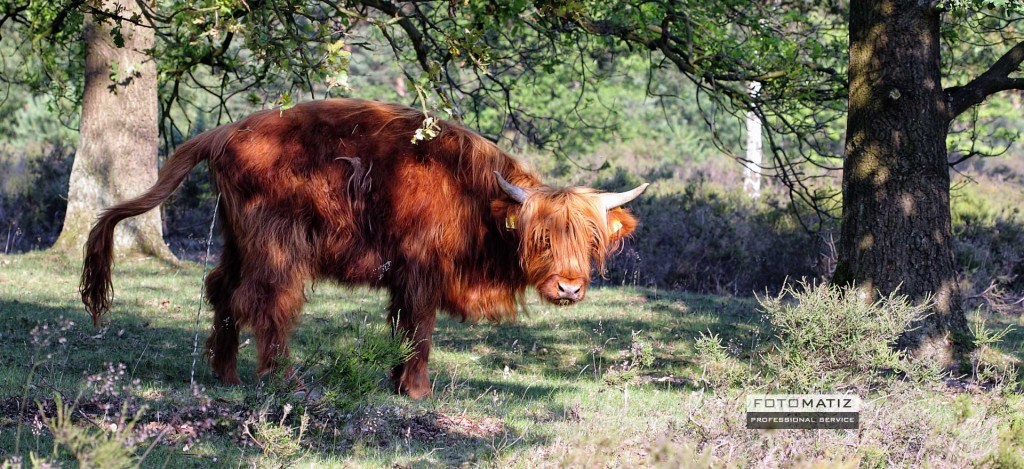
Scottish Highlander shot on a heath in Geldrop (Netherlands).
The Scottish Highlander is a mostly red-brown breed of cattle native to Scotland. They have long hair and long horns. The Scottish Highland Cow is the original cattle of the western highlands of Scotland and the Hebrides.
Until 1849 most Scottish Highlanders were black. The story goes that in the 1840s Queen Victoria visited the Scottish Highlands and expressed her preference for the red animals. She simply liked them better and gave the order to breed more red Highlanders. Besides black and red, there are also blond varieties. An adult bull weighs 800 kilos and a cow 500 kilos. The height at the withers is between 125 and 115 cm respectively. Scottish Highlanders can reach to life eighteen years old. During that time, a cow can give birth to about fifteen calves. The gestation period is about ten months. Cows have wide-spaced, upward-facing horns, while those of the bulls stand horizontally forward.
You can find them in nature and recreation areas
Thanks to their thick fur, this breed of cattle is suitable to be used as a large grazer all year round. In the Netherlands, the animals are frequently seen in nature and recreation areas. They need little care and are seldom aggressive, but in case of an unexpected confrontation cautious behavior is recommended. If kept at a distance, the animals will generally not be disturbed by human presence. Highlanders also feed on plants that ignore many other cattle species.
The Scottish Highlander was the only ancient primitive breed to survive in the rugged Highlands of Scotland. This resulted in characteristics perfect for independent survival in the wild, such as having a good winter coat. Nevertheless, the breed also has disadvantages. Not only does he have a thick winter coat, he also has a thick coat in summer. This ensures that the animals quickly warm up and like to cool down in the water. No problem in the river area, but in the upper reaches of brook systems this can lead to eutrophication of pools and brooks.
Photograph by Fotomatiz