The Story of the Crane Fly
Explore how an unexpected encounter with a harmless crane fly reveals an ancient insect’s short lifespan and deep evolutionary roots.
An Unexpected Encounter After a Long Day
Unloading camera equipment after a full day of shooting is usually a routine wrap-up to a photographer’s work. Yet, a casual glance toward the front bumper revealed a striking, melancholic sight resting against the license plate: a large, delicate crane fly, caught mid-journey by the grill of the car. These slender creatures frequently cross paths with human movement, bridging the gap between busy daily routines and the quiet, often overlooked world of insects. Finding one preserved against metal and paint offered a poignant moment to pause and appreciate a creature that has inhabited the planet far longer than humans.
Harmless Giants with Deep Evolutionary Roots
Despite their intimidating appearance, crane flies—belonging to the vast Tipula genus within the Tipulidae family—are completely harmless to humans. Often mistaken for oversized mosquitoes due to their exceptionally long legs and narrow bodies, these weak fliers lack the ability to bite or sting. The Tipula genus is extraordinarily diverse, encompassing over two thousand species distributed across the globe, from tropical rainforests to high northern latitudes and mountain elevations. Evolutionarily, crane flies are true survivors. Fossil records indicate their ancestors first appeared during the Middle Triassic period, roughly 245 million years ago, making them one of the oldest known groups of flies on Earth.
A Fleeting Life Cycle Focused on Renewal
The adult stage of a crane fly is remarkably brief, typically lasting only ten to fifteen days. During this short window, their primary focus is locating a mate to ensure the continuation of their species. Most adult crane flies do not feed at all, while a few species sip small amounts of nectar or pollen to maintain their energy. In contrast, their larvae—which thrive in moist soil and decaying organic matter—play a very different role in local ecosystems. While certain agricultural species like Tipula paludosa can impact crop growth by feeding on root systems, crane fly larvae remain a vital food source for birds, amphibians, and other wildlife in healthy natural habitats.
Where Technology and Nature Intersect
Seeing this ancient insect pinned against a modern vehicle serves as a powerful reminder of how human infrastructure constantly overlaps with the natural world. A routine drive along regional roads represents just a brief moment in human time, yet it intersected with the end of a delicate, ten-day life cycle. Photographing this scene transformed a simple everyday collision into a meaningful reflection on existence, evolution, and the quiet beauty of small creatures sharing our surrounding environments.
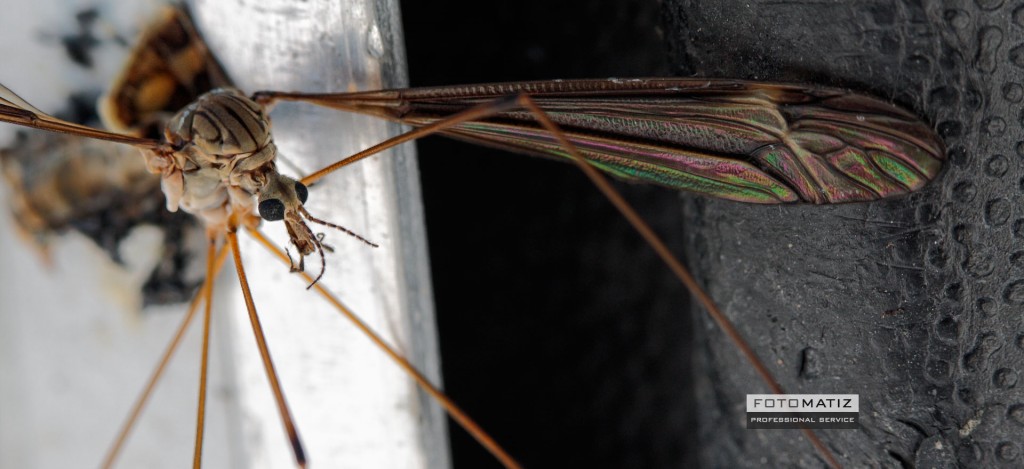
Colorful scene of a Crane-fly sticking to a cars number plate