Chasing High-Contrast Mountain Storms
Learn how to capture dramatic summer storms in the mountains. Master exposure control, high-contrast lighting, and visual framing in harsh environments.
Master Technical Landscape Photography
Predicting atmospheric conditions is a core skill for any serious landscape photographer. Before real-time satellite tracking and dedicated meteorological apps, field forecasting relied on observing cloud formations and reviewing evening broadcasts. In high-altitude terrain like the mountains of Murcia, Spain, rapid atmospheric shifts occur frequently, even during peak summer. Capturing these volatile transitions requires a sharp understanding of localized weather patterns and dynamic exposure management.
Overcoming Harsh Lighting and Low Saturation in Summer Landscapes
Summer photography in Mediterranean climates presents severe lighting challenges. Cloudless skies produce harsh, top-lit conditions with an excessively wide dynamic range. This results in washed-out colors, blocked shadows lacking recoverable detail, and desaturated blue skies.
To capture compelling imagery, photographers must capitalize on rare atmospheric breaks—such as storm fronts, localized rain shafts, or heavy cloud cover. These conditions act as a massive natural diffuser, softening intense sunlight, balancing overall scene contrast, and dramatically boosting natural color saturation across the arid terrain.
Technical Field Execution for Localized Storm Cells
Summer tempests in mountain valleys are typically brief, high-intensity, and hyper-localized. A single precipitation cell might drench a field while dry ground sits just a few hundred meters away.
Tracking a storm cell as it sweeps across a valley requires fast shutter speeds to freeze movement in windblown foliage or moving subjects, combined with an aperture optimized for maximum edge-to-edge sharpness—typically between f/8 and f/11. When shooting toward heavy rain shafts, using a circular polarizer helps reduce atmospheric haze and deepens contrast between the falling water and illuminated terrain.
Framing and Exposure: Foreground Interest and Environmental Scale
Technical precision must always support composition. In this framed scene near El Sabinar, dark, threatening rain curtains in the background contrast sharply with a warm, sunlit foreground.
Positioning a shepherd and flock across a freshly mown hayfield provides essential foreground interest and human scale against the towering weather system. The farmer loading hay onto a tractor-drawn trailer introduces authentic visual storytelling. By spot-metering on the brightest highlights where sun pierces the storm, you preserve clean highlight detail while retaining the ominous depth of the incoming rain clouds.
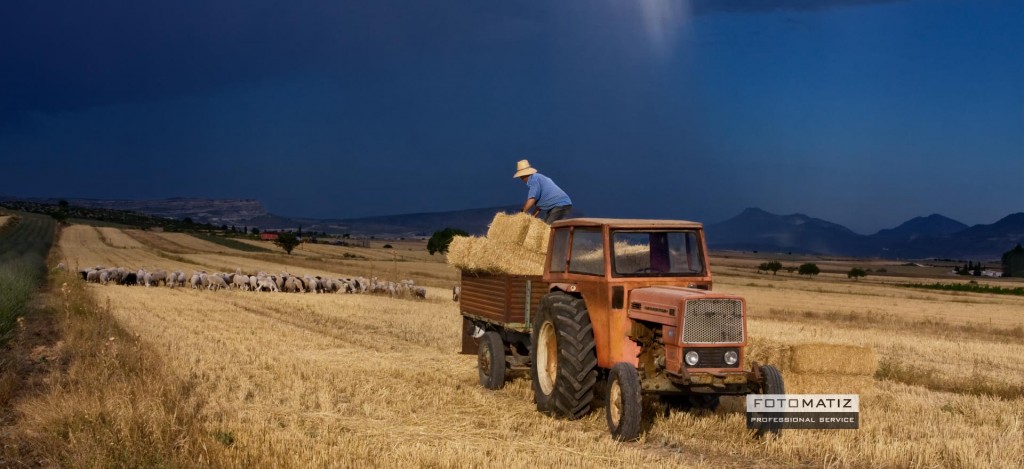
A farmer is trying to add the hay to his trailer before the summer storm reaches him.