Masters of Disguise: Discovering the Band-Eye Drone Fly
Explore how macro photography reveals the band-eye drone fly, a harmless bee mimic with striking, vertically striped compound eyes.
A Serendipitous Macro Photography Opportunity
Returning from a recent assignment, an overgrown garden fence split between bright sunlight and deep shadow provided an unexpected moment of visual inspiration. The surrounding air hummed with insect activity, signaling a prime opportunity to attach a dedicated macro lens. Direct sunlight combined with natural shaded backdrops creates ideal conditions for close-up photography, allowing high shutter speeds that freeze quick movements while naturally darkening the background. Warm weather makes insects far more energetic than during cool spring mornings, demanding quick reflexes to capture them as they visit flowers along a blooming privet hedge.
Unmasking the Hoverfly Mimic
While these fast-moving pollinators initially appeared to be honeybees, a closer look through the lens revealed a completely different creature. Many species in the hoverfly family (Syrphidae) employ impressive physical mimicry, sporting yellow and brown body patterns to imitate bees and wasps. Some hoverflies even pause motionless in mid-air to enhance the illusion, warding off potential predators despite being completely stingless. Nestled among the small white flowers sat a female band-eye drone fly (Eristalinus taeniops), a unique insect whose striking eyes made it an extraordinary subject.
The Distinctive Markings of Eristalinus Taeniops
The band-eye drone fly stands out from other hoverflies due to five distinct, dark vertical stripes running across its large compound eyes. Gender can be easily identified through eye placement: female specimens feature eyes that are clearly separated across the top of the head, whereas male eyes meet at the center. Despite sharing a verbal resemblance to the tiger mosquito, the tiger fly is entirely harmless to humans and serves as a quiet contributor to garden ecosystems. Adults feed peacefully on nectar from flowering shrubs and trailing ivy.
From Stagnant Waters to Sunshine
The life cycle of the band-eye drone fly is as fascinating as its adult appearance. Before maturing into agile, nectar-loving fliers, their aquatic larvae reside in stagnant, oxygen-poor mud and shallow water. Known colloquially as rat-tailed maggots, these larvae use a long, telescopic siphon tail that acts like a snorkel to breathe air from the surface while feeding underwater. Spotting these remarkable insects during a casual stroll demonstrates how macro photography can illuminate hidden biological wonders right on our doorsteps.
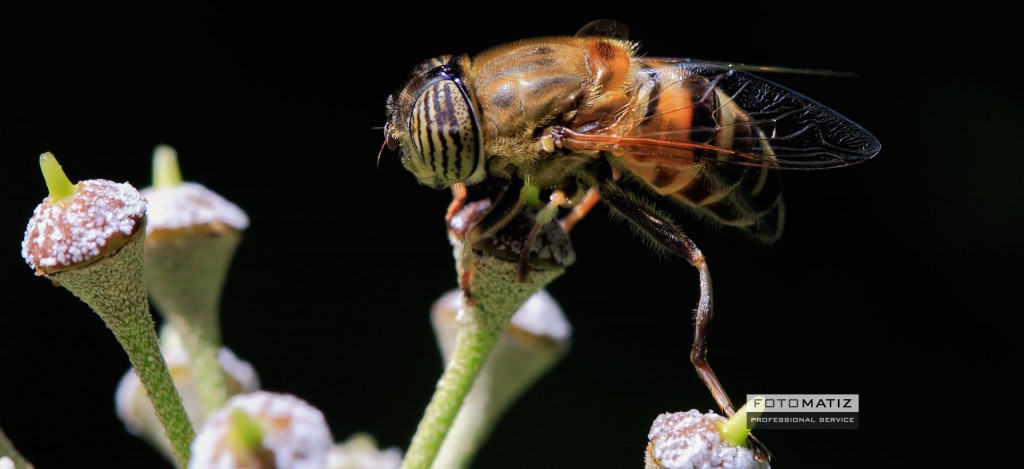
Little fly on a flower