The Art of the Microcosm
Learn how parallel alignment and black-and-white conversion transform a quiet encounter with a grasshopper into striking macro art.
Unlocking Hidden Details Close to Home
Macro photography offers an immersive portal into the intricate details of the natural world, extending far beyond its functional uses in commercial product work. By utilizing specialized lenses capable of achieving a true one-to-one magnification ratio, this discipline projects life-sized details directly onto the camera sensor.
Beyond technical precision, macro work serves as an engaging way to refine observational skills, maintain creative discipline for professional projects, and cultivate mindfulness without needing to travel far. Every quiet corner of a local neighborhood or home garden holds hidden artistic potential, turning overlooked everyday elements into captivating visual subjects.
A Quiet Encounter in the Cool Morning Light
During an early morning stroll through a quiet village, a remarkably large grasshopper was spotted resting motionlessly on the tip of an aloe vera leaf. Framed against the weathered, grey stone wall of a historic home, the creature remained perfectly still in the cool morning air.
Unlike smaller, nimble insects that quickly leap out of frame, larger grasshoppers often move deliberately, providing ample time to compose a thoughtful frame. This stillness allowed for careful observation of the insect’s impressive structure, offering a rare opportunity to capture an intimate portrait of rural wildlife.
Aligning Focal Planes for Maximum Sharpness
Working at extreme close-range presents distinct technical challenges, primarily an exceptionally shallow depth of field where only a razor-thin layer remains in sharp focus. To ensure the grasshopper’s entire body remained crisp, the camera lens was aligned precisely parallel to the insect, capturing the rich details of its protective exoskeleton.
Because the original natural colors—earthy brown against neutral grey stone—felt somewhat muted, converting the final image to high-contrast black and white dramatically elevated the composition.
The Timeless Appeal of Monochromatic Texture
Removing color shifts the viewer’s attention entirely toward shape, texture, and structural form. Drawing inspiration from classic black-and-white analog film techniques, monochrome conversion allows subtle light variations and bold geometric lines to define the visual story.
While color is sometimes essential for conveying context, black-and-white rendering simplifies complex scenes, ensuring that the remarkable texture of the subject remains the absolute hero of the frame.
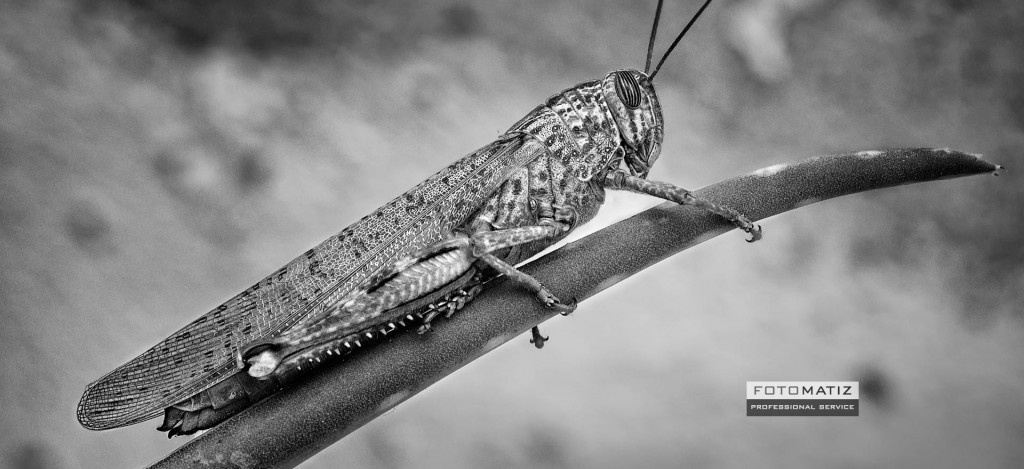
A big brown grey grasshopper holding on to a aloe vera leave