Documenting Pastoral Life in the Sabinar Valley
Discover the disappearing tradition of sheep herding in the Sabinar Valley and the photography techniques used to capture it up close.
The Changing Landscape of Inland Spain
In decades past, vast herds of sheep moving gracefully across the Sabinar Valley represented a defining symbol of daily life in the Spanish countryside. Over time, however, profound economic and cultural shifts gradually transformed this traditional landscape. Local families increasingly encouraged younger generations to pursue higher education and modern careers, stepping away from the physically demanding routines of agricultural labor. Simultaneously, evolving agricultural regulations and shifting market pressures made traditional sheep and goat farming far less economically viable for rural families. As a result, active pastoral herding has become an increasingly rare sight, making visual documentation of this enduring heritage all the more significant.
Getting Low for an Unconventional Perspective
Capturing these timeless pastoral scenes eventually provided iconic imagery for inland Spanish tourism campaigns, illustrating the quiet beauty of rural regions. To capture a genuine sense of connection between livestock and their environment, photographing from unexpected angles offered a fresh approach. Lying flat on the ground allowed the camera to frame the approaching herd from a dramatic, low perspective. Naturally, this unusual posture sparked equal parts curiosity and caution among the livestock. Sheep tend to be inherently skittish when observing someone lying still in the grass while a shutter clicks, and vigilant herding dogs often step forward suspiciously to inspect the unfamiliar presence before allowing the herd to move past.
Technical Precision with Telephoto Optics
Navigating these field conditions required careful technical preparation to capture fine details without unsettling the animals. Employing a 100mm lens provided an ideal focal length, allowing the camera to maintain a respectful distance while compressing the background to fill the frame with the moving flock. Furthermore, the short, cropped grassland provided a clean physical surface, ensuring that low foreground vegetation did not obscure the view. By combining field patience with an understanding of animal behavior, these field sessions captured memorable compositions that preserve the rich, living history of traditional Spanish agriculture.
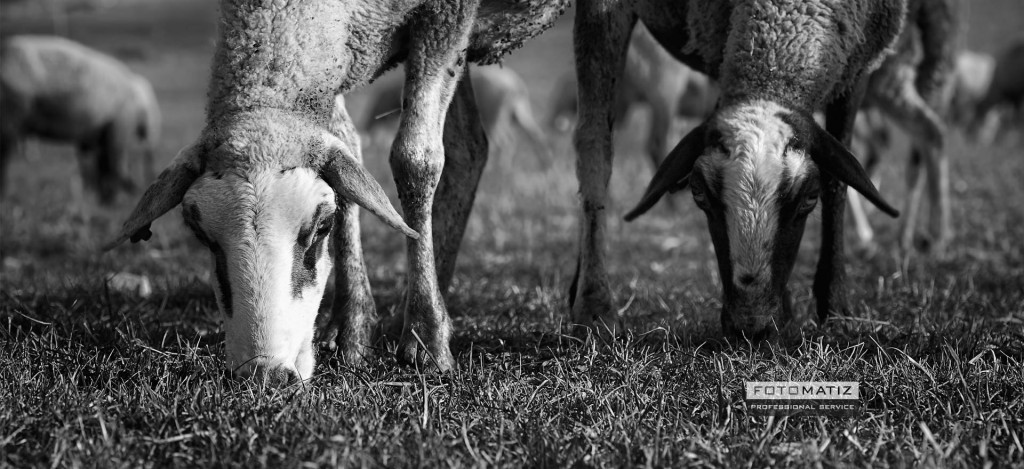
Grazing sheep hurdles in the Sabinar valley (Moratalla – Spain) are very common to spot.