Reimagining the Common House Spider
Uncover the micro-engineering of house spiders, from steel-strong silk to tiny, efficient brains, revealed through macro photography.Transforming Everyday Pests into Natural Allies
Fascination with the natural world often starts in the most unexpected places. While flying insects like mosquitoes can certainly test human patience, every creature fulfills an essential purpose within our shared environment. Spiders stand out as remarkably useful inhabitants of human homes. By quietly preying on flies and other unwanted bugs, a single resident spider acts as an effective, chemical-free pest controller. Beyond their practical utility in keeping indoor spaces clear, these eight-legged creatures showcase some of the most impressive feats of biological design found in nature.The Physics of Web Craft and Kinetic Precision
The intricate trap a spider constructs represents a triumph of natural material science. Spun from specialized glands, spider silk boasts a tensile strength greater than steel while retaining exceptional elasticity. Intricate web geometries feature sticky strands designed to entangle passing prey alongside non-adhesive radial lines that serve as highways for the spider. Thanks to specialized microscopic leg structures and careful foot placement, spiders scurry across their webs without becoming trapped in their own adhesive. Furthermore, rather than relying solely on their multiple eyes, spiders feel minute vibrations through delicate leg hairs. These vibrations act as a precise GPS, allowing the spider to pinpoint a trapped insect instantly, rush over, inflict a paralyzing bite, and bind the prey in a silk bundle.Big Intelligence in Microscopic Brains
What makes this predatory efficiency truly mind-boggling is the sheer computational economy of the spider’s central nervous system. Humans rely on an expansive brain containing roughly eighty-six billion neurons to process sensory input and coordinate movement. In stark contrast, a spider’s entire nervous system—known as a synganglion—contains anywhere from thirty thousand to six hundred thousand neurons. Despite operating on a tiny fraction of human neural capacity, this compact nerve cluster manages three-dimensional navigation, web geometry, motion tracking, and instant target acquisition. In tiny species, this neurological system is so dense that it overflows from the head into the legs, proving that complex behavioral mastery does not require vast physical storage.Uncovering Extraordinary Photography Close to Home
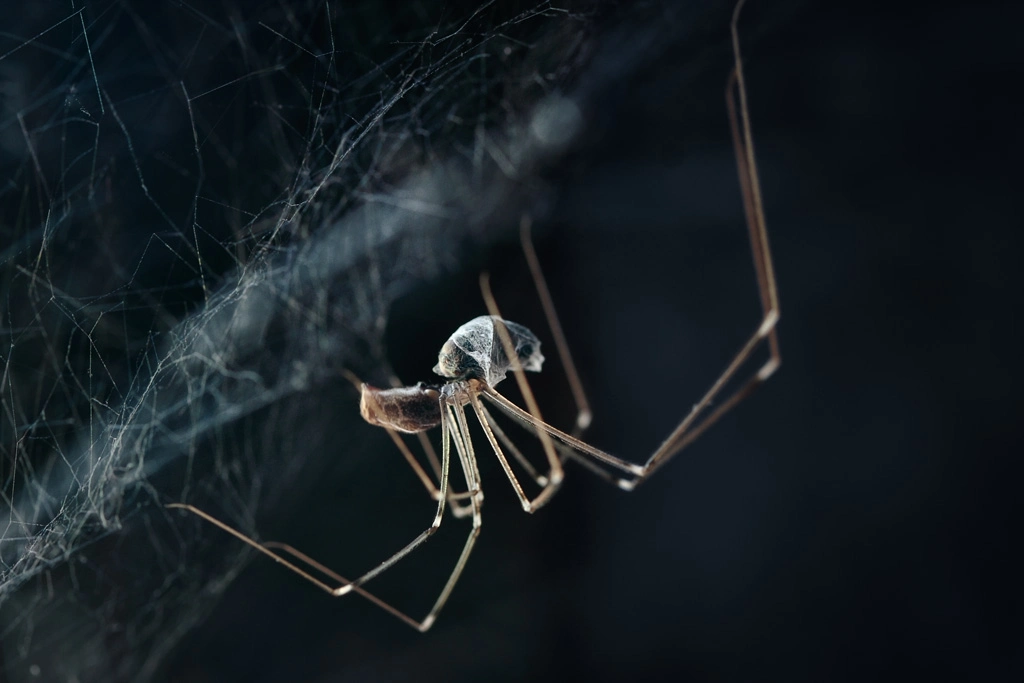
Documenting these intricate behaviors demonstrates that impactful macro photography rarely requires far-flung expeditions. An early test session with a newly purchased macro lens highlighted this reality in an ordinary dark garage. Light streaming through a solitary side window illuminated a quiet corner where a common house spider sat next to an entangled fly. The soft directional lighting brought out the rich textures of the web and the subtle form of the spider, turning an everyday scene into a striking study of light and shadow. Observing these overlooked creatures close-up reveals that remarkable stories are always waiting right under our roofs.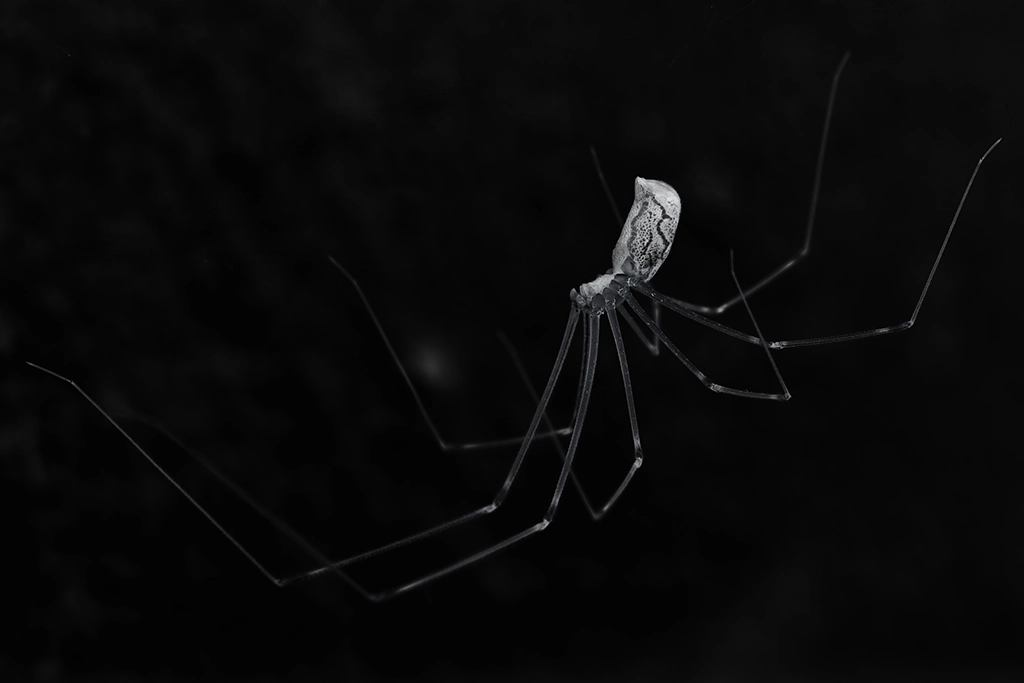
In a dark basement we located this little spider