The Architectural Genius of the Common House Spider
Discover the marvels of house spiders, from steel-strong silk to tiny, efficient brains, captured through the lens of macro photography.
The Unsung Heroes of Our Indoor Ecosystems
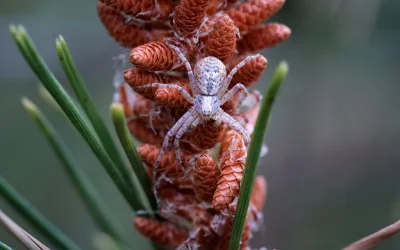
Nature’s design offers endless fascination, even when it comes to creatures that frequently make humans uneasy. While mosquitoes often rank among the least favorite insects, every organism plays a distinct role in keeping local food webs balanced. Spiders, however, earn a special place of appreciation as natural pest controllers. A single house spider quietly patrolling a dark corner can consume hundreds of unwanted flies and mosquitoes each year.
Beyond their practical household benefits, spiders represent absolute marvels of biological engineering. Their silk, produced by specialized abdominal glands, possesses a tensile strength comparable to high-grade alloy steel while remaining remarkably flexible. The secret to how spiders navigate their own sticky traps lies in careful biomechanics; they step primarily on non-sticky structural drag lines and possess specialized microscopic leg coatings that prevent adhesion, allowing them to glide effortlessly across intricate geometric webs.
Sensory Precision and Hunting Dynamics
What makes these arachnids even more astounding is their specialized sensory apparatus. Most spider species possess multiple eyes capable of detecting swift movements, but their primary link to the surrounding environment relies on subtle physical vibrations. Highly sensitive microscopic hairs lining their eight legs detect minute tremors traveling along individual silk strands.
When an insect becomes entangled, the spider calculates the exact coordinates of its prey almost instantly, eliminating any need for trial and error. Upon reaching the target, a precise venomous bite quickly immobilizes the insect, followed by a rapid wrapping process using fresh silk to preserve the meal for later consumption.
Astonishing Computing Power in a Microscopic Brain
Perhaps the most mind-boggling aspect of spider biology is the sheer efficiency of their central nervous system. The human brain processes thoughts, movements, and sensory input using approximately eighty-six billion neurons. In contrast, a spider operates with a compact neural cluster known as a synganglion, which contains merely thirty thousand to six hundred thousand neurons depending on the species.
Despite possessing a tiny fraction of human neurological hardware, spiders execute complex spatial mapping, precise web construction, three-dimensional navigation, and calculated hunting maneuvers. In exceptionally small spider species, this central nervous system is so proportionally massive that it actually extends into their legs, proving that sophisticated problem-solving does not require a large physical brain.
Capturing Hidden images Close to Home
This combination of delicate engineering and predatory skill makes spiders captivating subjects for macro photography. Documenting natural wonders does not require traveling to remote rain forests or foreign landscapes; remarkable stories unfold right inside our living spaces. An early macro photography experiment in a dimly lit garage highlighted this perfectly.
Illuminated only by soft directional light spilling through a single side window, a common house spider sat motionless beside a freshly secured fly. The contrasting shadows and glowing strands of silk illustrated how thoughtful lighting and close-up optics can transform an overlooked corner into a compelling visual narrative. By slowing down to observe these miniature architects, macro photography allows us to replace knee-jerk fear with genuine ecological appreciation.
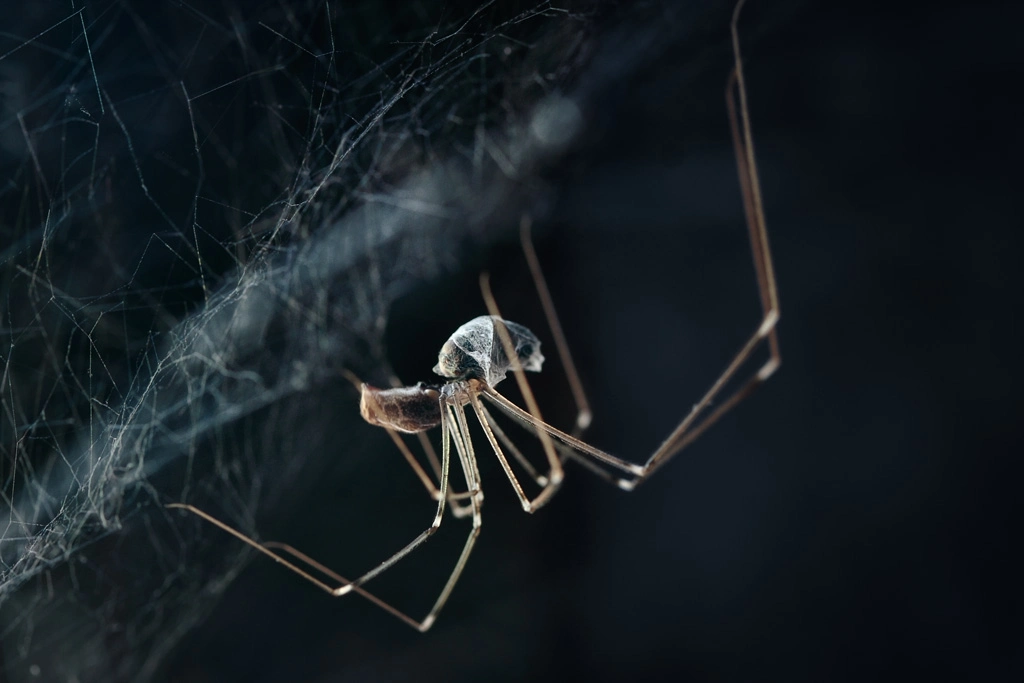
Shadows and Silk: Spider in de dark