Capturing Murcia’s Silkworms
Discover how Murcia’s historic silk tradition powers modern medical research and inspiring macro photography of silkworms creating cocoons.
The Evolution of Silk in Murcia
Historically, the region of Murcia in Spain served as a thriving center for traditional silk production. Over time, global market shifts toward lower-cost international manufacturing and the emergence of synthetic, petroleum-based textiles like polyester led to the decline of local commercial silk farming. However, this rich heritage remains remarkably active today.
Near historic growing grounds, the IMAS research institute continues to cultivate silk for groundbreaking European studies, exploring innovative medical applications for natural silk fibers. To support a municipal project highlighting this enduring legacy, a dedicated photographic assignment set out to document the complete lifecycle of the silkworm from feeding to cocoon construction.
Educational Connections and Nurturing Discovery
Mulberry trees, known locally as moreras, still dot the regional landscape as living reminders of Murcia’s agrarian past, providing the essential diet for growing silkworms. The local research institute routinely supplies boxes of silkworms to neighborhood schools, offering young students hands-on opportunities to observe growth cycles firsthand while learning to care for living creatures. Documenting these insects required dedicated research into both their biological behaviors and historical significance.
While silkworms move steadily rather than rapidly, their continuous motion demands quick technical adjustments and active observation, allowing photographers to anticipate their movements and frame precise compositions.
The Intricate Art of Cocoon Construction
The featured photograph captures a pivotal moment in the insect’s metamorphosis: the silkworm constructing a preliminary structural web before forming a protective cocoon at its center. Remarkably, the caterpillar weaves intricate scaffolding without becoming entangled in its own threads, shifting seamlessly from consuming foliage to spinning continuous silk fibers.
Observing this transition up close reveals the extraordinary mechanics of biological design, demonstrating how simple organic processes produce one of the strongest natural materials on Earth.
Preserving Heritage Through Macro Photography
Documenting this delicate transformation across several years provided valuable insights into macro photographic techniques and natural behavior. Fine-tuning lighting, depth of field, and shutter timing brings subtle textures and complex weaving patterns into clear view.
Through thoughtful visual storytelling, traditional silk cultivation is linked with contemporary scientific innovation, highlighting how historical roots in Murcia continue to inform modern research, ecological education, and artistic appreciation.
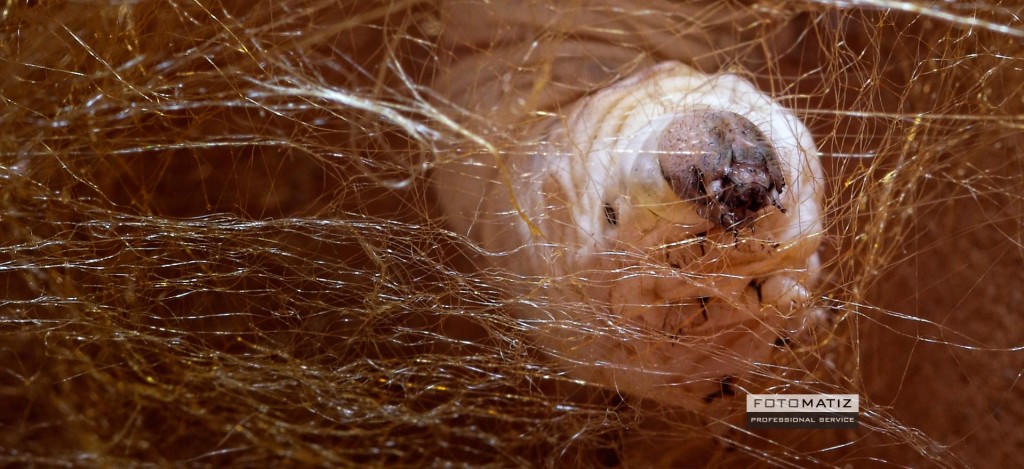
Silkworm building a cocoon photo from the silkworm 2011 project